
I’m excited to share that I will be presenting our recent work at the NeurIPS 2025 Workshop on Tackling Climate Change with Machine Learning in San Diego on December 7, 2025.
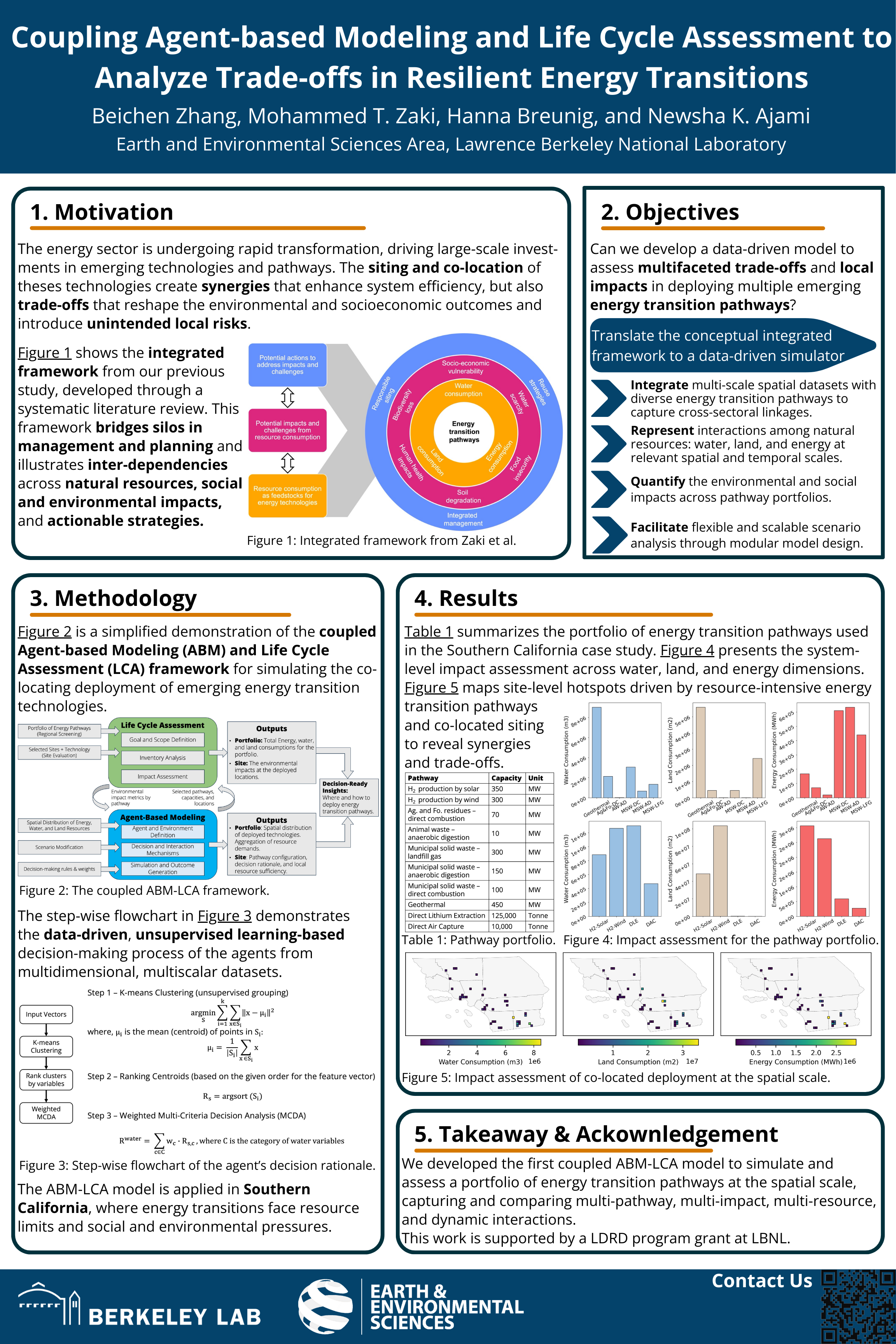
Building on our ongoing efforts at LBNL, I developed a coupled Agent-Based Modeling (ABM) and Life Cycle Assessment (LCA) framework to translate an integrated impact assessment structure into a quantitative model. This framework captures bidirectional interactions between decision-making and environmental impacts and is applied to a case study in Southern California.
Our poster, titled “Coupling ABM and LCA to Model Trade-offs in the Siting of Energy Transition Pathways,” highlights how data-driven simulation can uncover spatial trade-offs, resource constraints, and opportunities for more resilient energy transitions (slides and paper).
I’ll be presenting in person - please stop by if you’re attending NeurIPS!
Transitioning to sustainable and resilient energy systems requires navigating complex and interdependent trade-offs across environmental, social, and resource dimensions. Neglecting these trade-offs can lead to unintended consequences across sectors. However, existing assessments often evaluate the emerging energy pathways and their impacts in silos, overlooking critical interactions such as regional resource competition and cumulative impacts. We present an integrated modeling framework that couples agent-based modeling and Life Cycle Assessment (LCA) to simulate how energy transition pathways interact with regional resource competition, ecological constraints, and community-level burdens. We apply the model to a case study in Southern California. Results demonstrate how integrated and multi-scale decision-making can shape the energy pathway deployment and reveal spatially explicit trade-offs under scenario-driven constraints. This modeling framework can further support more adaptive and resilient energy transition planning across spatial and institutional scales.
#AI #Agent-Based Modeling #Life Cycle Assessment #Energy Transition #Impact Assessment #Conference