
AGU Fall Meeting 2025 will be held in New Orleans from 15–19 December 2025. My postdoctoral advisor, Dr. Newsha Ajami, will present our latest work on modeling the impacts and trade-offs of co-located energy transition pathways. This work represents the second phase of our LBNL LDRD-funded project.
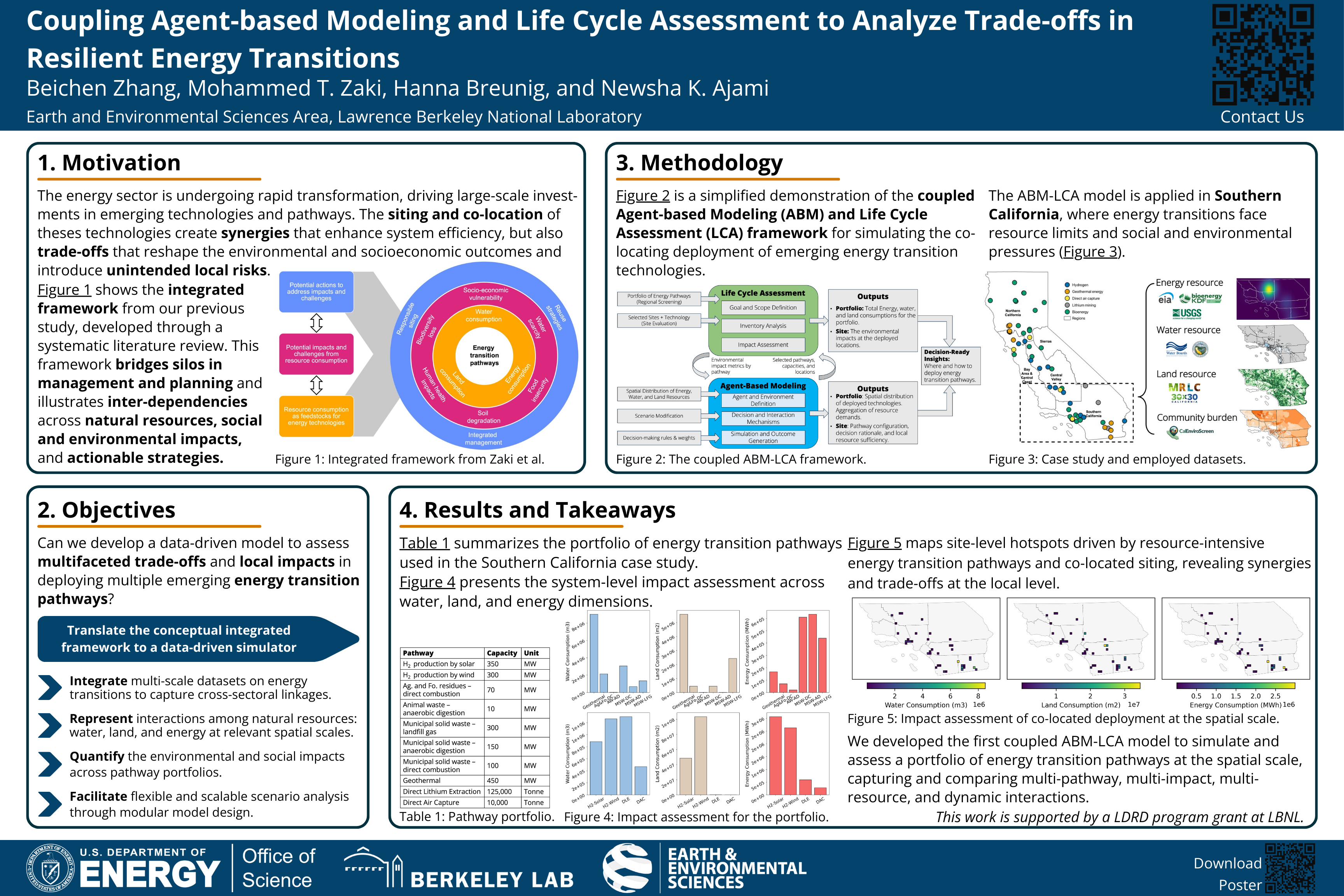
Building on the earlier work led by my colleague Dr. M. Tamim Zaki, I developed a coupled Agent-Based Modeling (ABM) and Life Cycle Assessment (LCA) framework that translates the proposed integrated impact assessment structure into a quantitative model. The ABM–LCA framework captures bidirectional interactions between impact assessment and decision-making, and we apply it to a case study in Southern California.
This work has also been accepted at the NeurIPS 2025 Workshop on Tackling Climate Change with Machine Learning (link).
Our poster will be presented from 2:15–5:45 pm on December 17 in the Poster Hall. Please stop by and say hello!
GC33G-0860: A Coupled Agent-based and Life Cycle Assessment Model for Analyzing Trade-Offs in Resilient Energy Transitions
Transitioning to sustainable and resilient energy systems requires navigating complex and interdependent trade-offs across environmental, social, and resource dimensions. Neglecting these trade-offs can lead to unintended consequences across spatial and institutional scales. However, existing assessments often evaluate emerging energy pathways and their impacts in silos, overlooking critical interactions such as competition for resources and synergistic effects. We present a novel integrated modeling framework that couples an agent-based model with life cycle assessment to explore how energy transition pathways interact with regional resource competition, ecological pressures, and community-level burdens. The model simulates the spatial deployment of selected emerging pathways, including waste-to-energy with carbon capture, hydrogen, geothermal, direct lithium extraction, and direct air capture, under varying scenario conditions such as drought and conservation policy. The model comprises specialized agents representing energy, water, land, and community dimensions based on unsupervised clustering. A centralized management agent performs multi-criteria decision analysis to rank potential sites, while a transition agent allocates resources and infrastructure. These management and transition agents interface with the life cycle assessment module, executed at both the pathway portfolio and site-specific levels, to incorporate environmental impacts into each decision-making step. We apply the model to a case study in Southern California. By combining scenario-driven system constraints with localized deployment dynamics, the results illustrate how pathway portfolios, environmental stressors, and policy priorities can shape siting decisions as well as cumulative environmental and community burdens. Our integrated approach provides an extensible and comparative tool for benchmarking various energy transition pathway portfolios under different scenarios. It can further inform adaptive and sustainable energy planning across local, regional, and institutional contexts.
#AI #Agent-Based Modeling #Life Cycle Assessment #Energy Transition #Impact Assessment #Conference